What Is Time to an Animal? A New Discovery in the Brain
マウスの脳内に時間を測定する「時間細胞」が発見されました。この細胞は一定時間、順に活動することで時の経過を脳が記憶する仕組みを示唆しており、動物の時間の概念や人間の記憶解明に繋がる画期的な発見です。
Our human lives are organized by clocks, calendars, and schedules. We are accustomed to measuring time in seconds, minutes, and hours. But how do animals perceive time? Do they have a sense of "now" and "later"? A recent and significant study published in the journal Science has provided an insightful answer, revealing a surprising discovery inside the brain of a mouse. This research, which builds upon previous findings in rats, has found specific brain cells that seem to measure time itself.
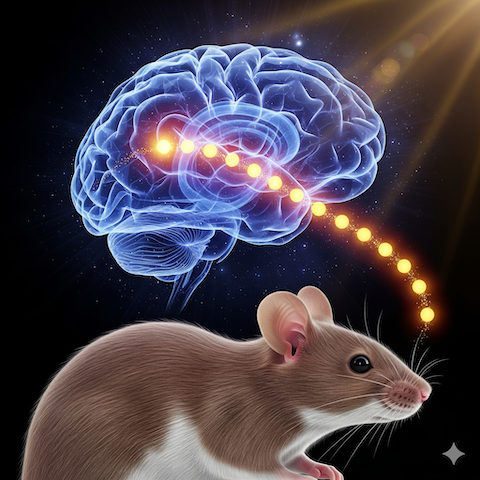
The research team set up an intricate experiment to understand how a mouse's brain recognizes a specific amount of time. Mice were trained to push a lever and then had to wait a definite amount of time—for example, six seconds—before they could get food. This task forced the mice to concentrate and correctly estimate the time interval to get their reward. While the mice were performing this task, electrodes were placed in a part of their brain called the hippocampus, a region well-known for its role in memory.
What the scientists discovered was remarkable. They found that as the mice waited, a specific group of nerve cells in the hippocampus began to activate one after another. This sequential firing pattern was a direct reflection of the passing time. These special nerve cells, which the scientists called "time cells," worked together to encode the precise length of the time interval. The unusual pattern of their activity gave the mouse's brain a way to "remember" how much time had passed, which was crucial for completing the task correctly.
This fascinating discovery suggests that an animal's brain does not perceive time like a digital clock ticking away. Instead, it seems to perceive the flow of time as a sequence of activity among these nerve cells. This phenomenon is similar to the way that certain nerve cells in the hippocampus, known as "place cells," become active when an animal is in a specific location in its environment.
This groundbreaking research has profound implications. It indicates that the feeling of "time passing" might be a process in the brain where it compares past events and memories with its current circumstances. The comprehensive findings from this study are a fundamental step toward a deeper understanding of animal behavior and the mechanisms behind human memory and time perception. This new knowledge could also contribute to our awareness of how living organisms function and adapt to their environments.