
The Unseen Persistence: Navigating the Complex Legacy of "Forever Chemicals"
炭素とフッ素の強固な結合を持つPFASは、水を弾くなど便利な特性から広く利用される一方、「永遠の化学物質」として環境や人体に蓄積し、健康被害を引き起こす問題が深刻化。規制や代替物質の開発が急務となっています。
現在、この長文の音声は準備中です。
In the quest for convenience and technological advancement, humanity has often embraced innovation with open arms, sometimes only realizing the full extent of its consequences much later. Among the most pressing of these delayed reckonings are per- and polyfluoroalkyl substances, commonly known as PFAS, a vast family of synthetic compounds. These substances, due to the exceptionally strong carbon-fluorine bond at their core - one of the most stable in organic chemistry - are so resistant to natural degradation that they have earned the disquieting moniker: "forever chemicals." Their story is one of remarkable utility intertwined with profound environmental and health concerns, a narrative that is still unfolding and demanding our urgent attention.
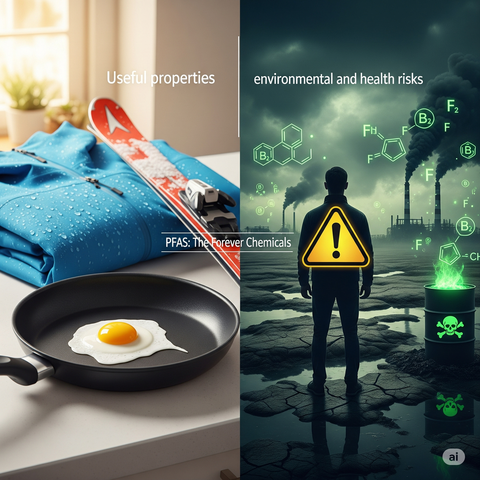
The very properties that make PFAS so problematic in the environment are, ironically, what made them initially attractive for a multitude of applications. Imagine a frying pan, its surface so slick that food slides off effortlessly; this is often the work of PFAS. Consider waterproof clothing that keeps you dry in a downpour, or food packaging that prevents grease from seeping through; again, PFAS are frequently involved. "For decades, the unique ability of these compounds to repel both water and oil, coupled with their thermal stability, made them seem almost miraculous," explained Dr. Aris Thorne, a materials scientist who has studied their properties. "From high-performance outdoor gear and cosmetics to critical industrial applications like firefighting foams, vital for extinguishing challenging fuel fires, and even in the sophisticated processes of semiconductor manufacturing, their presence became ubiquitous." Indeed, it is this very chemical stability, this resistance to breaking down, that allows them to persist, not just in our products, but far beyond their intended use.
However, this extraordinary persistence has a darker side, the full implications of which science is now earnestly endeavoring to understand. Specific PFAS, notably perfluorooctane sulfonate (PFOS) and perfluorooctanoic acid (PFOA), have come under intense scrutiny. A growing body of research, which has been accumulating over several years, links exposure to these compounds with a disturbing array of health problems. "The challenge with PFAS," stated Dr. Lena Hanson, an epidemiologist specializing in environmental health, "is that they can accumulate in the human body over time. We are investigating significant associations between long-term exposure and effects such as a compromised immune system, which can make individuals more susceptible to illnesses, and various forms of liver damage." Furthermore, studies have pointed towards connections with thyroid diseases, elevated cholesterol levels, and, alarmingly, an increased risk of certain cancers, including kidney and testicular cancer. Pregnant women and developing fetuses represent a particularly vulnerable population, with some research suggesting a link between PFAS exposure and lower birth weights, a factor that can have lifelong health consequences. What is particularly troubling is that these substances, once introduced into the body, are not easily expelled.
The journey of PFAS does not end with their presence in consumer products or even within our bodies; their environmental footprint is equally, if not more, concerning. Through various pathways, including industrial emissions, the use and eventual disposal of PFAS-containing products, and even the application of certain firefighting foams, these chemicals have found their way into virtually every corner of our planet. Soil, groundwater, rivers, and even the vast oceans have become reservoirs for these persistent pollutants. "The problem," commented Kenji Ito, an environmental chemist during a recent symposium on persistent organic pollutants, "is not just their resistance to degradation. It is also their mobility. Once in the water systems, for instance, they can travel considerable distances, contaminating drinking water sources far from the original point of release." This widespread contamination has long-term ecological impacts. Because they do not readily break down, PFAS can bioaccumulate, meaning their concentrations increase as they move up the food chain. Consequently, high levels of these chemicals have been detected in wildlife, particularly in fish, marine mammals, and predatory birds, posing a threat to entire ecosystems.
Faced with mounting evidence of their potential harm, the international community has begun to take action. Several countries, including the United States and many European nations, have implemented or are strengthening regulations concerning the use and emission of specific PFAS, particularly PFOS and PFOA. Setting stringent limits for these chemicals in drinking water has also become a priority. Japan, too, is responding to these global concerns. The Ministry of the Environment has established environmental quality standards and target values for PFOS and PFOA in soil, groundwater, and public water bodies. "We are closely monitoring the international regulatory landscape and scientific findings," a government official, speaking on condition of anonymity, recently noted. "There is an ongoing discussion about revising our own drinking water guidelines to align with, or even surpass, the stricter standards being adopted elsewhere. The public's health is, of course, a primary consideration."
The path forward, however, is complex. While regulatory action is crucial, the challenge extends to finding safer, viable alternatives for the myriad applications where PFAS have become entrenched. Significant research and development efforts are underway to identify and commercialize substances that can offer similar performance characteristics without the associated environmental and health burdens. This transition, while essential, requires considerable investment and innovation from industries worldwide. Moreover, the issue of remediating existing contamination remains a formidable task. How do we effectively remove these "forever chemicals" from our soil and water? Current technologies are often costly and only partially effective, highlighting an urgent need for novel cleanup strategies.
In conclusion, the story of PFAS serves as a compelling, if cautionary, tale about the double-edged sword of chemical innovation. The very resilience that made these compounds so useful now presents a profound and enduring challenge to environmental integrity and human well-being. It underscores the critical need for thorough lifecycle assessments of new materials and a precautionary approach to substances whose long-term impacts are not fully understood. As future medical professionals, understanding these environmental health linkages will be increasingly vital. The legacy of "forever chemicals" demands not only scientific ingenuity and regulatory diligence but also a heightened sense of collective responsibility to safeguard the health of both current and future generations. The decisions we make today regarding these persistent substances will, quite literally, shape the environment for a very long time to come.