The Hidden Power of Handwriting: More Than Just Words
筆跡学によれば、手書きの文字は単なる記録ではなく、書き手の性格を映し出すものです。デジタルの時代において手書きは失われつつありますが、学習効果や認知能力の向上に繋がり、また個性を表現する貴重な手段でもあります。
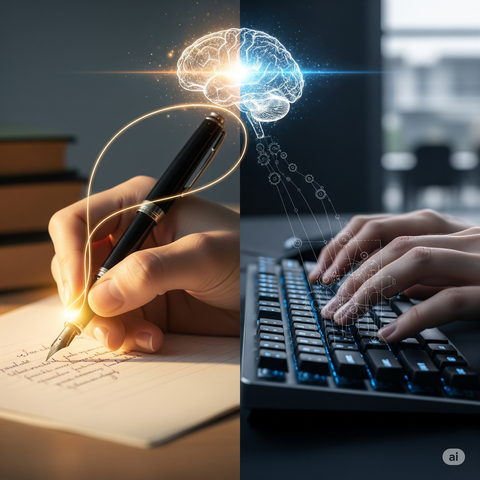
In our digital world, where we type on keyboards and touch screens all day, the art of handwriting seems to be disappearing. Yet, the way a person writes can reveal much more than the words themselves. The study of handwriting, known as graphology, suggests that the loops, curves, and slants of our letters can offer a deep insight into our personality. While it may not be a perfect science, the unique act of putting pen to paper connects us to our minds in a way that technology cannot, creating a direct link between a person's thoughts and their physical movements.
To understand this better, consider the famous manuscripts of the great composer Ludwig van Beethoven. His notebooks were often a mess of corrections, with words crossed out and musical notes written with intense, forceful strokes. His handwriting was chaotic and difficult to read, reflecting a passionate and, at times, turbulent personality. His letters showed a strong, almost aggressive slant and an uneven size of writing, which can be seen by some as a sign of his great energy and his emotional struggles. In Beethoven's case, his handwriting was not just a way to put his thoughts on paper; it was a physical expression of his intense inner world. This connection between the physical act of writing and the writer's inner state is what makes handwriting so fascinating to psychologists.
This relationship between handwriting and the mind is not just a historical curiosity. Research has shown that the act of writing by hand, compared to typing, has a stronger connection to learning and education. When a student writes notes by hand, their brain has to work harder, forming letters and connecting thoughts in a way that helps them remember information better. The physical effort of writing strengthens neural pathways, which can lead to a deeper understanding of the material. In contrast, typing is a more mechanical process that does not require the same kind of complex brain activity. Many teachers and educators still believe that handwriting is a key part of developing a student's cognitive skills.
Today, we face a big question: as we move from tradition to technology, what do we lose when we stop writing by hand? While computers make communication faster and easier, they also create a certain distance between our minds and our words. A typed email or text message, while efficient, does not carry the unique personal touch of a handwritten letter. The individual style of a person's writing—the care they take with each letter, the way they use space on a page—is a part of their identity. The challenge for modern society is to find a way to use the speed of technology without losing the benefits of older methods that have been important for thousands of years. The act of handwriting may seem small, but its power to connect us with ourselves and others should not be forgotten.