
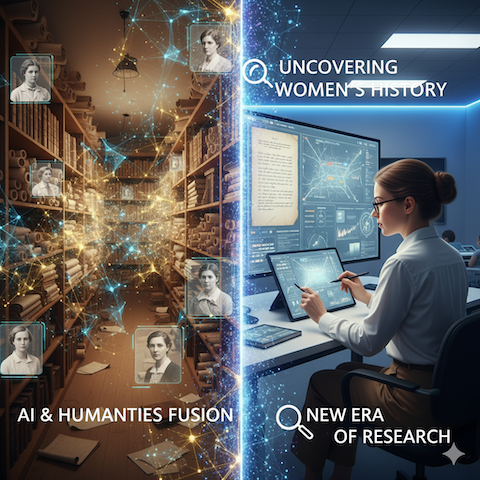
Resurrecting Herstory: AI's Role in Uncovering Women's Hidden Contributions
AI技術と人文学の融合により、アイルランドや米国などで、これまで歴史の記録から見過ごされてきた女性たちの貢献をアーカイブから発掘する動きが加速しており、テクノロジーと人間の専門的検証を組み合わせた新たな歴史研究が潮流となっている。
現在、この長文の音声は準備中です。
For centuries, the grand narrative of history has been dominated by a select few, leaving the contributions of countless individuals, particularly women, relegated to the footnotes or omitted entirely. However, a paradigm shift is underway, driven by the potent combination of artificial intelligence and digital humanities. Across the globe, pioneering projects are leveraging technology to excavate the marginalized voices of women from the depths of archives, thereby forging a more inclusive and accurate understanding of our past. This burgeoning field, where technology and historical scholarship converge, is illuminating the invaluable, yet hitherto invisible, roles women have played throughout history.
This movement is exemplified by several groundbreaking international initiatives. In Ireland, the VOICES project, led by Trinity College Dublin, employs AI to sift through vast collections of 16th and 17th-century primary sources, such as court documents and wills. Its objective is to extract the experiences of ordinary women, effectively resurrecting their voices to reconstruct the historical narrative. Similarly, in the United States, a collaboration between the Smithsonian Institution and Google Arts & Culture utilizes machine learning to analyze immense metadata archives. By deploying techniques like named-entity recognition, the project visualizes the networks and scientific achievements of female researchers and engineers whose work had been obscured. Meanwhile, the UK's Beyond Notability project focuses on women in more modest roles within the heritage sector of the 19th and 20th centuries, compiling their records into an open-access database that facilitates a digital re-evaluation of their work.
Underpinning these endeavors is a sophisticated symbiosis of technology and human expertise. AI tools like Transkribus are revolutionizing historical research by automating the transcription of handwritten manuscripts, making once-inaccessible documents available for large-scale analysis. Yet, this is not a complete automation. The process critically incorporates a "human-in-the-loop" approach, where historians and researchers provide the nuanced interpretation and meticulous verification that algorithms alone cannot. This fusion ensures both the scale of data processing and the scholarly rigor required for historical inquiry. It represents a new frontier where data visualization and computational analysis are not replacing traditional historiography but are profoundly augmenting it.
The impact of this technological turn extends beyond academic circles, fueling a broader movement in feminist research and digital activism. Initiatives like the Women Writers Project digitize historical works by female authors, enabling new forms of literary analysis, while grassroots campaigns such as Wikipedia's "Women in Red" actively work to increase the digital representation of notable women online. Consequently, the application of AI in history is more than a methodological innovation; it is a conscious effort to correct a long-standing imbalance in our collective memory. By systematically unearthing and amplifying the stories of women, this techno-historical approach is not just adding names to a timeline—it is fundamentally reshaping the very fabric of history into a more equitable and comprehensive chronicle of humanity.