AI Minds: Can Neural Networks Truly Learn Creativity?
この記事は、AIは本当に創造的になれるかという問いを探求。ニューラルネットワークはパターン学習で驚くべき成果を出す一方、人間の感情や意図を欠く。その可能性と限界、倫理的な課題までを論じます。
Artificial intelligence, transforming industries from medicine to entertainment, has reached a point where its potential seems limitless. Among its most fascinating tools are neural networks, systems inspired by the human brain, designed to process vast amounts of data with remarkable speed. These networks power everything from voice assistants to image recognition software, achievements once thought impossible. Yet a question lingers in labs and classrooms alike: Can machines, built on logic and patterns, truly learn creativity—a trait so deeply tied to human experience? Scientists, exploring this frontier, offer answers that both inspire and puzzle.
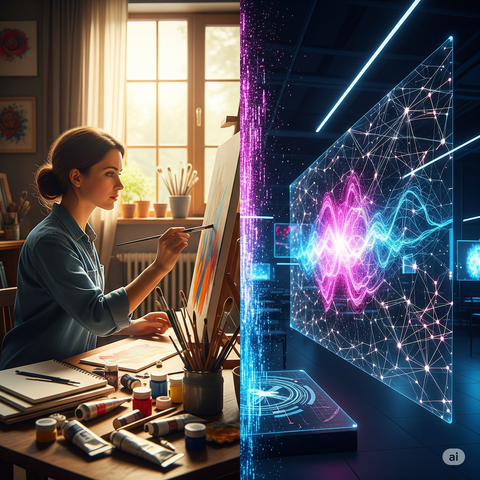
Neural networks operate by mimicking the brain's structure, a web of connections adjusting itself as it learns. Data flows through layers of artificial neurons, each tweaking its response based on examples it receives. For instance, a network trained on thousands of paintings can generate images, blending colors and shapes in ways that resemble art. Researchers at MIT, studying this process, found that their AI, exposed to countless landscapes, produced scenes with unexpected details - a river curving through a desert, glowing under a strange sky. While impressive, this output, often celebrated as creative, raises doubts about whether it reflects true invention or mere imitation.
The idea of creativity, long debated by philosophers, involves more than combining existing elements. Humans imagine, invent, and express emotions, often breaking rules to craft something entirely new. A painter, inspired by a storm, might splash chaotic lines across a canvas, driven by feelings machines cannot grasp. Neural networks, however, rely on patterns they've been fed, lacking the ability to feel or dream. Although their results can surprise us, critics argue that this surprise stems from complex calculations, not from the spontaneous spark that defines human art. This gap, subtle yet profound, challenges the notion of machine creativity.
Despite these limits, advances in AI suggest a different perspective. Scientists have developed generative adversarial networks (GANs), a system where two networks compete - one creates, the other critiques. This rivalry, pushing the creator to refine its work, has led to stunning outcomes. A GAN trained on music, for example, composed a melody that listeners, unaware of its origin, praised as moving. Such success hints that creativity might not require emotion, but rather a process of exploration and adaptation - qualities neural networks can simulate. Researchers, observing this, wonder if human definitions of creativity, rooted in our own minds, need rethinking.
The training process itself offers clues. Unlike humans, who draw inspiration from life's chaos, neural networks depend on structured data. A child, watching clouds shift, might sketch a dragon without ever seeing one, an act of pure imagination. In contrast, an AI, lacking such freedom, needs millions of examples to produce anything novel. A team in Japan, training a network on haiku, found it could mimic the form—five-seven-five syllables—but its verses, though polished, echoed the samples too closely. This reliance on input, a strength in pattern recognition, becomes a weakness when originality is the goal, leaving experts divided on AI's creative potential.
Yet some argue that creativity lies in the unexpected. Neural networks, processing data at scales humans cannot, sometimes stumble into uncharted territory. A project in Europe, feeding an AI abstract art and random noise, produced shapes no artist had conceived - twisted forms pulsing with energy. While the machine followed its programming, the result, striking and unfamiliar, felt like a leap beyond its training. Scientists, analyzing these outputs, suggest that creativity might emerge not from intent, but from complexity itself - a theory that blurs the line between human and machine.
This possibility excites educators too. In universities, students use AI tools to explore design, music, and writing, sparking debates about authorship. A professor in Tokyo, guiding students through an AI-generated story, noted how they reshaped its bland draft into something vivid, blending their ideas with the machine's framework. This collaboration, merging human insight with computational power, hints at a future where creativity is shared. Rather than replacing artists, neural networks might amplify them, offering raw material that humans refine—a partnership challenging traditional views of invention.
Still, obstacles remain. Neural networks, excelling at tasks with clear rules, falter when ambiguity reigns. Poetry, thriving on emotion and subtlety, resists their grasp. An AI, tasked with writing a sonnet, produced rhymes that fit the meter but lacked the depth of Shakespeare's sorrow. Researchers, adjusting algorithms to capture nuance, find that the more they tweak, the less predictable the outcome becomes—a paradox mirroring human struggles with inspiration. This unpredictability, though frustrating, suggests a glimmer of creative potential, one that science cannot yet fully measure.
The ethical side also looms large. If machines create art, who owns it? A company in California, selling AI-generated paintings, faced lawsuits from artists claiming theft of style - a legal tangle unresolved. Beyond ownership, there is a deeper concern: if neural networks mimic creativity too well, will they devalue human effort? Critics, warning of this risk, urge limits on AI's role, while optimists see it as a tool to push boundaries. This debate, unfolding in journals and courtrooms, reflects society's unease with machines that blur human uniqueness.
Can neural networks truly learn creativity? The answer, elusive as the concept itself, depends on how we define it. If creativity means breaking molds and evoking wonder, AI's achievements - however mechanical - suggest a partial yes. Yet if it demands emotion, intent, or a soul, the gap remains wide. Scientists, standing at this crossroads, continue their work, training networks that surprise and challenge us. For now, the question lingers, a puzzle as intriguing as the machines it probes, inviting us to rethink what it means to create.